deaf children in canada
20•04•2026
Canada 2026 – Deaf Children and Sign Language, what is happening to the future generations?
For a complex language and culture to grow and evolve, we need close geographical proximity that permit human and language contact. This way we can learn to communicate with each other and develop our ways of life, the culture. For it to continue through centuries, children are our transmission means. This is obvious, of course.
As long as history has been recorded, deaf people have been seen to use sign language in public – the moving hands and not normal. This mindset stems into the decision-making on behalf of audio centric and phonocentric services and parents of deaf children – away from deaf children’s natural and innate language, which is sign language and into enforced unnatural language, spoken language. In turn, deaf children grow up with similar lived experiences. They experience a restricted quality of education, literacy, identity, social skills, mental health, employment, and/or advocacy.
Now, I want to put light on the historical facts by citing from some sources:
Oral Education as Emancipation.
After the Civil War, education reformers urged schools for deaf children to fundamentally change their teaching methods. Reformers wanted to eliminate “manualism,” the use of sign language, and replace it with “oralism,” the exclusive use of speech and lipreading. Residential schools, from their beginnings, had conducted classes in sign language, fingerspelling, and written English. Lessons in lipreading and speech had been added to the curriculum at many schools in the 1860s, but for advocates of oralism this was not the crux of the issue. They opposed sign language, believing that it slowed the development of speech and set deaf people apart from society. […] Oralists believed that signing oppressed and isolated deaf people and invited discrimination – since it set them apart from the general population. Speech was the way to “emancipate” them. Many deaf leaders profoundly disagreed, and portrayed oralists themselves as oppressors of deaf people.
La communauté sourde de Montréal et ses institutions.
Dans les deux écoles, on instaure dans les années 1880 un volet strictement oral, en séparant les élèves en deux groupes distincts : d’un côté, les élèves de la méthode « mimique » et de l’autre les « parlants ». Non seulement sont-ils placés dans des classes différentes, mais chaque groupe dispose de sa propre salle de récréation. Au Québec, la langue des signes, inspirée des langues des signes française et américaine, en est encore à ses balbutiements, et les éducateurs préfèrent miser sur l’enseignement de la langue orale, dans l’optique de permettre aux sourds de fonctionner dans un monde où domine la langue parlée.
Deaf and Hard of Hearing Youth in Ontario: A Snapshot of Systemic Barriers and Gaps.
Throughout the section, we have identified many possible points where D/HH students in Ontario could easily fall through the cracks in the educational system without anyone noticing until it is too late. The first red flag is the lack of capacity of the Ministry of Education to detect and track all D/HH students in Ontario’s educational system due to incomplete and inaccurate data collection and reporting. […] With new legislation comes a necessity of replacing or overhauling existing systems, but this is not happening. Instead, there is a patchwork of systems, supports, and services that are relics of the medical model-based approach along with new systems of supports and services that align with the social model-based approach in Ontario. At the same time, some medical model-based supports and services were removed without any social model-based or equivalent replacements; thus, creating bigger cracks where D/HH and disabled people can fall through. Very much akin to systemic racism, is systemic ableism and audism. We can clearly see where D/HH youth fall through the cracks especially with the post- secondary education enrollment.

BC Government Blamed as Deaf Kids Lose Key Support.
“I haven’t seen any data that say the status quo is working right now,” she said. “We still have children in B.C. who are not entering kindergarten with a full language. That’s not to blame anyone for it, it’s just a fact. To me that’s not acceptable, for any children to enter kindergarten without a full language.”
Audiologists and others involved in early intervention have tremendous influence on what parents will decide about language acquisition for their children, but they may not have the full picture of what’s best for each child, she said.
“Their default is, as a medical professional, which I understand, is to see it as a medical problem that they must fix and they default to their own native language of English and spoken language because that’s what’s accepted by the majority of society, and that’s concerning.”
The best practice is to expose children to both ASL and spoken language, then assess them over time to make sure they are progressing in at least one language, she said. Later the child may gravitate to one or the other depending on what works best for them.
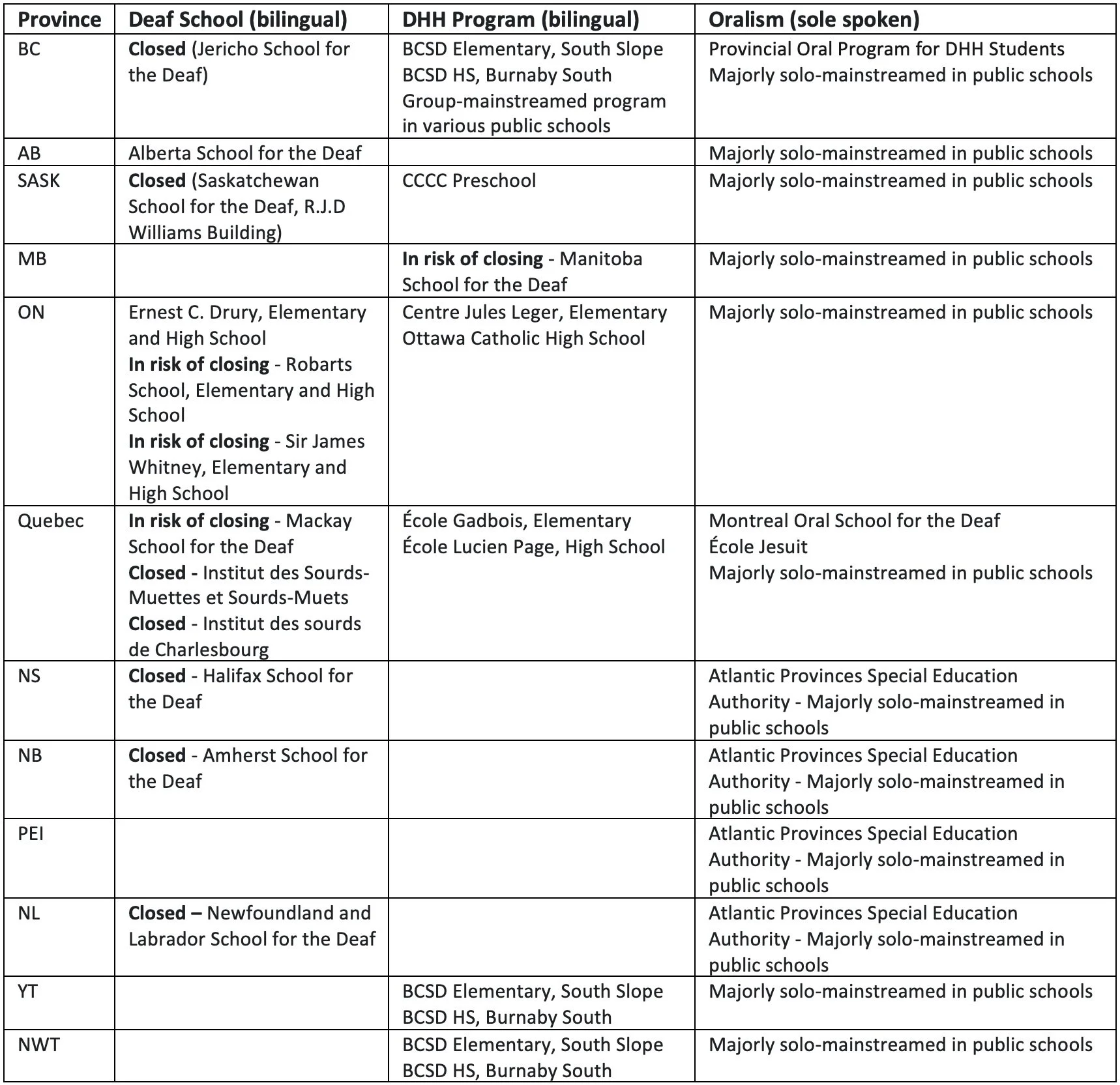
Canadian Portrait of Deaf Education, 2026
Majorly mainstreamed. Some itinerant teachers travel to other provincial schools for one-on-one support to solo-mainstreamed or group-mainstreamed students. There are talks around professional and community members that some itinerary teachers and professional service providers who tell the students it’s better to speak, to use their ears and audible voice, that they are not encouraging the use of sign language. Based on my personal and professional experience, I can confirm this to be true.
There are some Deaf & Hard-of-Hearing programs in hearing schools, using the schools and buildings to provide resources and spaces for the programs. Methods of teaching vary between the use of Total Communication, Signing Exact English/French, Simultaneous Communication, Oralism, Bilingualism, LPC Code, Sign Language.
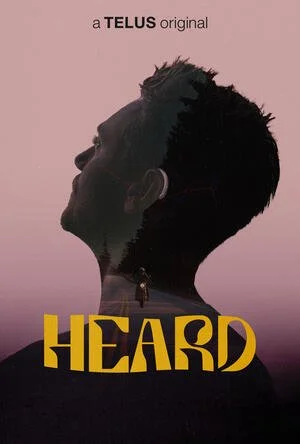
The recent release of a 2026 documentary film “HEARD” made by a hard-of-hearing (HoH) writer and director, Brian Ceci discussed the spectrum of Deaf and HoH, signed languages and spoken languages, and identities. The documentary chronicles Brian’s experience growing up with hearing aids to exploring what it means to be a person living through a HoH identity while searching for community as a Hard of Hearing person.
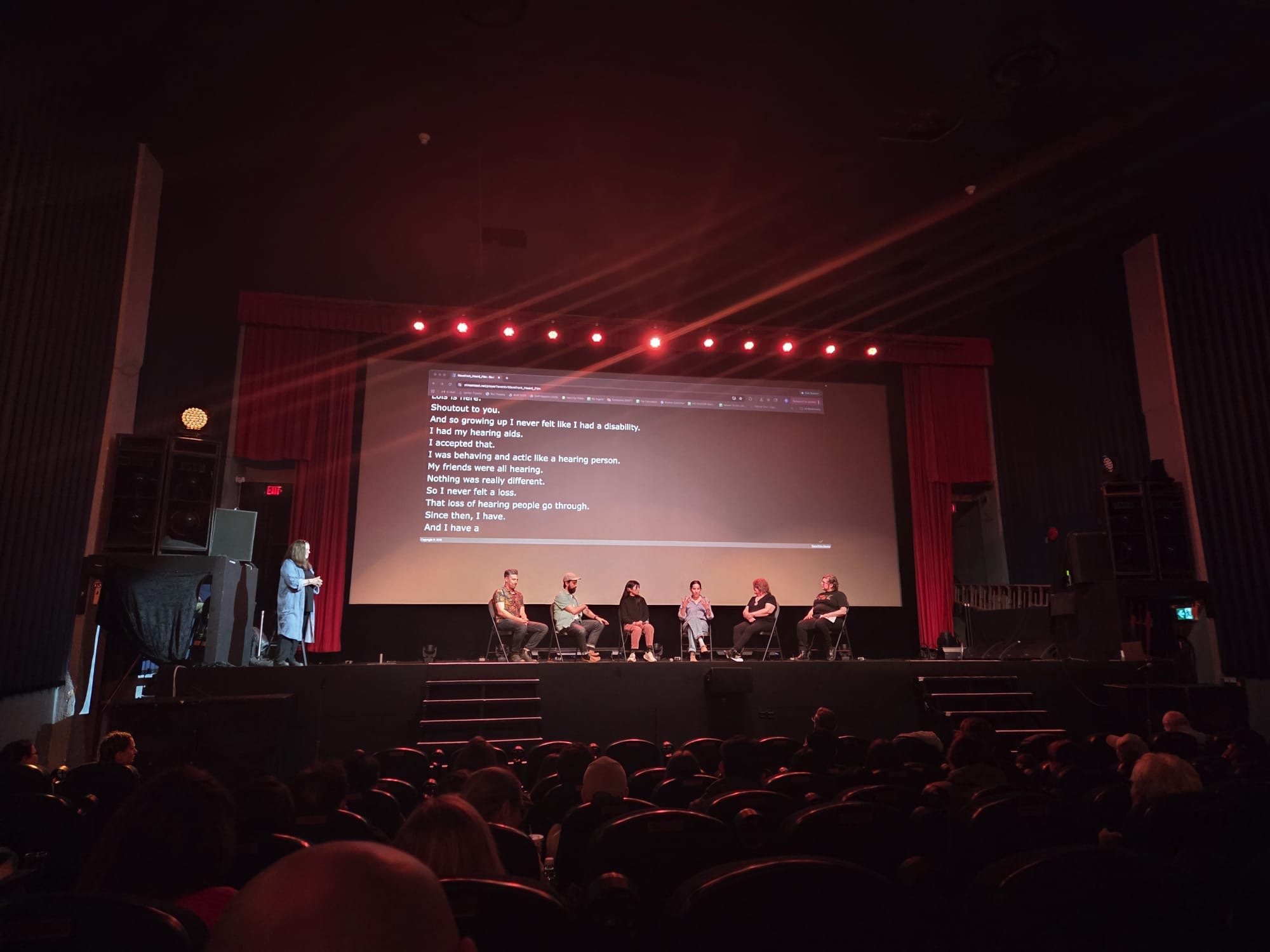
After the screening, there was a panel discussion with documentary participants. Below is the Q&A content that the moderator, Pamela Witcher developed for the panellists: Brian Ceci, Kelsie Grazier, Laurie Landry, Ruzzelle Gasmen, and Joseph Martin.
The answers unfortunately have not been recorded.
Moderator Pamela (signs, Deaf, wears no devices)
At the beginning of the film, I see a flashback there, back into the childhood as a deaf child with the HEARD seen on the school supplies, blackboard, and our hands through fingerspelling… and then there is the sound box with the audiologist.
I am not sure if you know this, but there are more than 50 deaf genes, the one that causes a sudden overnight hearing loss, the one that transmits the half-half, deaf ears and hearing ears, the one that associates the deaf gene with the blind gene called Usher’s Syndrome, or the Waardenburg Syndrome, representing deaf people having skin pigmentation varieties, blue eyes and white hair… There are the Connexin 26 or 46 carrying onto 10% pool of babies born deaf.
I am the Connexion 26; my family is deaf. Even though I was raised in a deaf culture, community and sign language. I still went through an identity crisis in my late teen years and young adulthood because we have been constantly taught that hearing knows best, hearing is smart, hearing is normal.
There are many different pathways of experience, different journeys, but what we all have in common is that we live in an audio centric society, a society that colonizes our identity as a deaf or hard-of-hearing person, where we are constantly told we are not normal. To be normal, the doctors tell our parents that their children need to blend into the audio centric world. I would like to explore this with all of you.
Questions for Brian (speaks, HoH, wears hearing aids, wants to learn to sign).
My favourite message is asking my hearing percentage like I am a cell phone battery about to die. This could become many metaphors.
You saw Liam trying to explain “sliding” by acting out the word on his chair. Your dad was also gesturing to you, explaining how to use a camera (go back and forth to adjust the frame size). At a young age, gestures are intuitively used to get our messages across. Growing up, you did not meet any other deaf or hard-of-hearing children, and I do wonder why. Your Dad mentioned “they recommended to fit you with hearing aids,” and I am assuming “they” would be the audio centric professional service providers (doctors, audiologists, intake team players).
You said you saw Liam as a younger version of yourself. How did you feel at that moment? If you go back to that age, what message would you have for yourself and your parents or for Liam and his parents? What would you wish to have occurred otherwise to ensure that you did not live in isolation, that you would have a community? Have any mentions or thoughts of developing American Sign Language at home during the conversations between the professional service providers and your parents?
Questions for Joseph (half-deaf, speaks, HoH, does not wear devices).
My favourite message is: The first thing is always the seating strategy. I do a quick calculation about what’s available and who’s coming in. I pick an optimal spot because it affords me the ability to sort of collect as much information as possible.
The nodding part is funny because it is very common, until we learn the hard way. Your case seems to be different from the others; you were hearing at birth, you grew up hearing and then, you went half deaf by the age of seventeen.
You mentioned the use of space. The deaf community has discussed the Deaf Space and how it is very important to us. You mentioned the seating space. What other use of space do you calculate or best organize for the best accessibility to information? Over the past 10 years, you decided to reframe your mindset; look at things with more positivity, see how to better connect with people, and continue your dream as a musician, despite being deaf in one ear. Do you feel content, or do you still feel the missing piece? Can you please elaborate?
Questions for Ruzelle (speaks, HoH, wears hearing aids)
My favourite message is the idea behind hearing aids blending into hair and skin is part of the problem that we have, where hearing aids should be something that you hide. As in, being deaf is something to be ashamed of, but it should not be that way.
I find it interesting that you had no idea of your hearing loss until that neuroscience class; that tells us of your high adaptability capacity throughout your journey before you realized you are hard of hearing, unless you became hard of hearing on the very day you found out, which I doubt to be the case.
Brian saw Liam as a younger version of himself, and everyone here has heard his story.
Since the beginning of history, as far as it goes, there has always been a controversy that deaf children should not learn a sign language, as it is a non-intellectual language, and they cannot be blended into society to pass as normal. The 1880 decision, the famous Milan decision, where it was made when a group of hearing people decided that sign language was to be banned from the education system.
I have met and worked with many different service providers; there are some service providers working with deaf babies and children who can speak in sign language, and some cannot. Some of them are against sign language, some are not. As a professional service provider, an SLP working with young deaf and hard-of-hearing children, what is your view on this? What is your perspective on supporting the language development in sign language as a Language Pathologist or a Speech/Sign Language Pathologist? Have you considered taking this kind of direction to ensure deaf and hard-of-hearing children have equal access to both languages?
Questions for Laurie (signs, speaks, Deaf, wears hearing aids)
My favourite message is Chiquita doesn’t know that she’s deaf. It doesn’t stop her from being a dog. And I think that’s when I learned I don’t know what it’s like to be hearing. Why would that stop me from living my life?
Not being deaf enough or not being hearing enough. It has been known that there is a spectrum of perspectives and criticisms within the deaf community: not being deaf enough because we can speak, not being hard of hearing enough because we sign, and being judged by each other for our strengths and weaknesses that support sign language or oralism. All of this, all those attitudes, stem from audism, formed by hearing values that colonized our attitude and mindset. Did that experience working with other deaf staff in the federal government office have an impact on your identity growth? What would you like to see done differently in the community to ensure a balanced collectivity?
From your experience and perspective, if, as a deaf community, we have a perfect and ideal life in the present society, how should it be? You have mentioned the captioning part, and what else?
Questions for Kelsie (signs, speaks, deaf, wears cochlear implants)
My favourite message is I really felt comfortable saying that I’m Deaf. And that is also a huge part of how the community is changing. The community is changing by accepting the spectrum of deafness and acknowledging that there’s difficulty in everyone’s experiences.
I have tinnitus as well, and I empathize with you in this area. You lived through a transition from hard-of-hearing to deaf to Deaf. How did you decide your identity to be labelled from past Hard of Hearing to now Deaf with a capital D? When did you first learn to sign? If you go back to when you were a child, would you wish for a different journey? If so, how?
Generally, the deaf people have been labelled as silent, that we lead a silent life, which is not true from our own stance. Our lives are noisy, but I am not only talking about auditory noises but also all the life, visual and moving noises. The deaf community has been discussing the ownership of sounds, as in how we define our own sounds and rhythms, and the organized visual sounds through sign language. You mentioned the auditory memory, and that not everyone has access to that. What is auditory memory, and what is not? What is your perspective on this?
Pamela:
Often, I hear from people of similar experiences that we withdraw from speaking out because we do not want to hurt our family, who loved us and raised us, when in fact it isn’t them who we should be looking at, but at the systemic attitude. The influence of the audio-centric professional services and system on the decision-making and processing. I want to say BRAVO to the writer/director and panellists for being brave, for taking the courage to step up and talk about the famous hidden topic that has been around for a very, very long time. We need more testimonials like what we just saw, for a future of a more child-centric approach.
Two questions that are important to discuss, yet when it was brought up during the panel period, they were not yet responded in its full clarity. The moderator asked, “Growing up, you did not meet any other deaf or hard-of-hearing children, and I do wonder why.” as in, why were you alone? Why did you not meet other children like you? and one of the spectators came up on the stage and asked, “How can signing and speaking adult, deaf and hard-of-hearing, work together to ensure the next generations do not continue to live in the harm of the systematic decisions?” Those two questions are good questions, and yet, they remain a taboo… they cause discomfort and remain not answered.
This may be seen as a conspiracy theory and a forever-denied one but most of it stand true, based on what has been shown in the history; hence, not a theory but a fact. As of today, in 2026, I believe 80% (more or less) of deaf and hard-of-hearing children are solo-mainstreamed. I believe we are separated on purpose because the audio centric system knows the power of the close geographical proximity that ignites language spark through human contact. Therefore, the system has established a constraint strategy to prevent the contact and growth of sign languages. They have decided to isolate deaf children and denied by providing various probability reasons that can make sense and they are using the family-centric approach as an easy excuse when it has more to do with their own benefits: profession, fame, wealth. The audio centric values have to stop.
Our future becomes our history. Changes begin with us. Let’s work together, deaf and hard of hearing who share similar lived experiences and talk this through. In the best interest and well-being of the future deaf children and their families, a child-centric approach should be taken more seriously.
location: canada.
language: american sign language, langue des signes québécoise, english, french.
